So can fellowship help with the disease of White racism? It’s the one practice in this handbook I haven’t tried as of this writing, but I’m willing to bet that it does, especially since I treasure the moment when, in an Al-Anon meeting, I confessed to being wary of other White people and saw what we call “empathic nods” from some of my White fellows in the circle.
So could there be something like Wypipo Anonymous? Wypiponics Anonymous? A nonhierarchical small-“d” democratic structure for such groups has already been well established by Al-Anon, and if groups like this followed the ground rules for Al-Anon meetings they might very well be helpful. They would certainly not be heavy-duty encounter groups, since by now we know that the whole point of criticizing and finger-pointing is to establish that I’m not the one with the problem, you are. We can be grown up enough to talk about our experiences of White racism and be lifted up by the empathic nods, while refraining from crosstalk and advice-giving. Just knowing that we’re not alone is healing, and working together can have a synergistic effect: we’re not unwelcome to borrow from other cultures an awareness of a “group soul” that is greater than the sum of its parts.
Or there may be people who, after trying out these and perhaps other healing practices on themselves and finding them good, would like to form a healing circle to do the practices in this book together and explore new ones, or set up workshops that can be free, nonhierarchical, and small-“d” democratic, a full expression of the values we seek to live. Perhaps you’d like to bring it to a group of people you already belong to and do spiritual practices with, and each participant can contribute on an equal footing, rotating leadership of practices and learning by doing just how sweet non-hierarchical small-“d” democracy can be. Or there may be drumming circles that would like to explore healing of White racism through their shamanic practices.
Here’s a picture of the drum I use for community healing work. 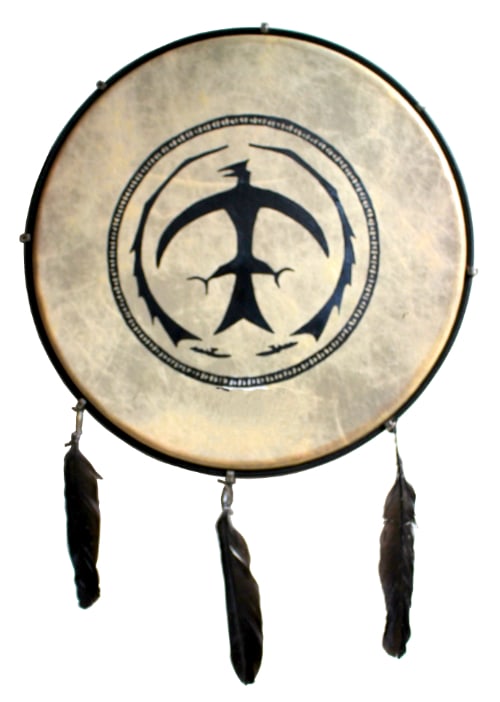 The design comes from the shield of Sitting Bull, because after the policemen who killed Amadou Diallo were acquitted, I had a vision of a Sitting Bull Brigade, which could be a coalition of healers from many traditions, serving the community of political activists. I imagined that the healers might have some work to do among ourselves, given some of the histories, and then we could go to work to heal people traumatized in the quest for justice. Amadou Diallo, you may or may not recall, was struck and killed by 19 of the 41 bullets cops shot at him at relatively close range as he was turning away from them and reaching for his keys. They did not mistake his wallet for a gun: he never got his wallet out of his pocket.

Here’s a picture of the drum I use for community healing work. The design comes from the shield of Sitting Bull, because after the policemen who killed Amadou Diallo were acquitted, I had a vision of a Sitting Bull Brigade, which could be a coalition of healers from many traditions, serving the community of political activists. I imagined that the healers might have some work to do among ourselves, given some of the histories, and then we could go to work to heal people traumatized in the quest for justice. Amadou Diallo, you may or may not recall, was struck and killed by 19 of the 41 bullets cops shot at him at relatively close range as he was turning away from them and reaching for his keys. They did not mistake his wallet for a gun: he never got his wallet out of his pocket.
71